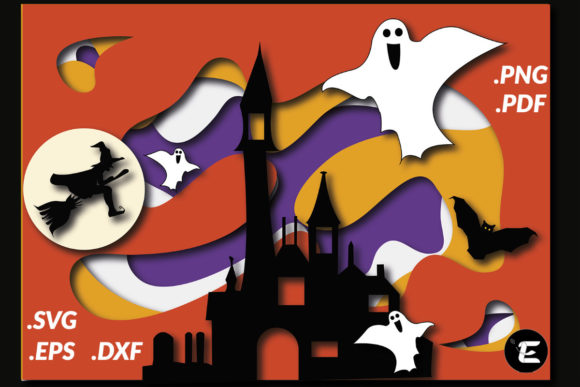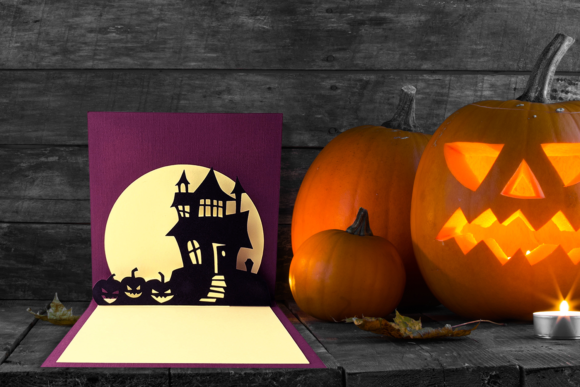
Review: Halloween Haunted House Pop Up Card SVG for Crafters
As a designer who spends more time staring at stitch maps than most people spend watching television, I approach every new digital embroidery file with a mix of excitement and skepticism. We have all been there: you buy a design based on a glossy thumbnail, only to find out the stitch density is so high it turns your fabric into cardboard, or the details are so fine they vanish under a standard needle. When I first opened the Halloween Haunted House Pop Up Card SVG, my immediate reaction was to look past the "spooky" aesthetic and evaluate its structural integrity for real-world application.
This isn't just a flat graphic; it is a 3D SVG intended for paper crafting, specifically falling under the Pop-Up Cards category. However, in our line of work, we often need to adapt assets across different mediums. The question I asked myself wasn't just "Is this cute?" but rather, "How does this translate if I want to use this motif on a custom apparel item or a handmade product for my shop?"
First Impressions and Visual Personality
The mood of this design is undeniably festive without being overly aggressive. The silhouette of the haunted house carries a classic, storybook charm that feels appropriate for a wide demographic, from kids' parties to boutique home decor. Visually, the layout is balanced. The front of the card is intentionally blank, which is a brilliant move for customization. For an Etsy seller or a small shop product creator, this negative space is gold. It allows you to add a monogram, a date, or a specific message without fighting against existing stitch patterns.
When evaluating the lines for potential conversion to a machine embroidery design, the shapes appear clean. There are no erratic nodes or unnecessary complexity that usually causes thread breaks. The architectural elements of the house—windows, rooflines, and the general structure—are distinct enough to hold up well when digitized into satin stitch or fill stitch. If you are planning to use this as an applique design, the boundaries are clear, making it easy to cut fabric pieces that align perfectly with the stitched outlines.
Real-World Application Scenarios
Let's talk about a concrete scenario. Imagine you are preparing a batch of orders for a local boutique that wants exclusive holiday embroidery items. You could take the core shape of this haunted house and apply it to a heavy-weight canvas tote bag design. Because the original file is a vector-based 3D SVG, you can scale it precisely to fit a 5x7 hoop or larger, ensuring the proportions remain crisp.
Alternatively, consider a sweatshirt embroidery project. A oversized, centered chest print of this haunted house, perhaps done in a textured running stitch to mimic a sketch, would look incredible on a heather grey fleece. The blank front area mentioned in the description allows for personalization—maybe adding "Trick or Treat 2024" in a complementary font below the house. This transforms a simple digital asset into a high-value personalized gift.
For those running a craft business, versatility is key. This design could easily be adapted for an embroidered patch. By tightening the stitch density and using a merrow edge border, you create a wearable accessory that customers love. It also works beautifully on home goods like pillow covers or kitchen towels, where the stark contrast of a black haunted house against white linen creates a striking visual impact.
Technical Considerations and Fabric Choices
While the design shows promise, practical execution requires caution. If you are adapting this digital embroidery file for use on stretchy fabrics like jersey knits for baby embroidery projects, you must be mindful of the stabilizer. A design with sharp corners and structural lines needs a cut-away stabilizer to prevent distortion after washing. On textured fabrics, such as waffle weave towels, fine details might get lost, so simplifying the smaller windows or door details might be necessary.
Dark fabrics present another challenge. If you are stitching this onto a black hoodie, the traditional orange and black color scheme won't work. You would need to rethink your thread colors, perhaps opting for metallic golds, silvers, or even neon greens to ensure the design pops. Always test your design on scrap fabric first. What looks good on the screen might behave differently when the needle hits the material.
Curved surfaces, like caps, require special attention. The rigid geometry of a house can look distorted if not positioned correctly on the front panel of a hat. Ensure your hoop size is adequate to keep the fabric taut without crushing the brim. Also, be wary of dense stitch areas on thin materials; too much thread buildup can cause puckering, ruining the professional look of your finished product.
Enhancing Brand Value and Customer Trust
Using a well-thought-out design like the Halloween Haunted House Pop Up Card SVG directly impacts your brand consistency. When customers receive a custom apparel item where the stitching is crisp and the design is coherent, it builds trust. They see you as a professional, not just someone clicking "start" on a machine. The ability to customize the blank front area adds a layer of exclusivity that mass-produced items cannot match.
For commercial embroidery projects, presentation is everything. Whether you are creating printable mockups for your online store or displaying physical samples at a craft fair, the clarity of this design helps. It photographs well, which is crucial for Etsy listings and social media marketing. A clear, recognizable silhouette stops the scroll and engages potential buyers.
Designer Notes for Success
Before committing to a full production run, here are a few practical steps I recommend:
- Check Licensing: Since this is marketed primarily as a card design, verify the license terms before selling finished embroidered items or digital adaptations. Ensure commercial use is permitted.
- Test Stitch Density: If digitizing this yourself, run a test on similar weight fabric to ensure the fill isn't too dense, which can cause needle deflection.
- Contrast Check: View your design in black and white mockups to ensure the value contrast is sufficient for visibility from a distance.
- Detail Inspection: Zoom in on the smallest elements, like window panes. If they are too small for your needle size, simplify them.
- Stabilizer Selection: Match your stabilizer to the fabric texture. Water-soluble might work for towels, but cut-away is safer for garments that will be worn and washed frequently.
In conclusion, the Halloween Haunted House Pop Up Card SVG offers a solid foundation for creative entrepreneurs. While it originates in the world of paper crafts, its clean lines and customizable nature make it a strong candidate for adaptation into various embroidery projects. With careful attention to fabric choice, thread selection, and technical setup, this design can elevate your small shop product lineup this Halloween season. It is a reminder that with the right eye, a single design asset can transcend its original category and become a staple in your design assets library.